Skip to the page
Shore House PipesSouth Jersey shore, season by season
Procedures
OD-2Opening day

Find the leaks winter left behind

To find a water leak in a shore house after winter, read the water meter, use no water for two hours and read it again; any change means water is escaping somewhere, so then check toilets with dye and walk the pipes under the house.

Time: 2 to 3 hours, mostly waitingWho: YouWhen: Spring, the same day the water goes back on

By the Shore House Pipes editors · sources checked October 31, 2026 · how this manual is written
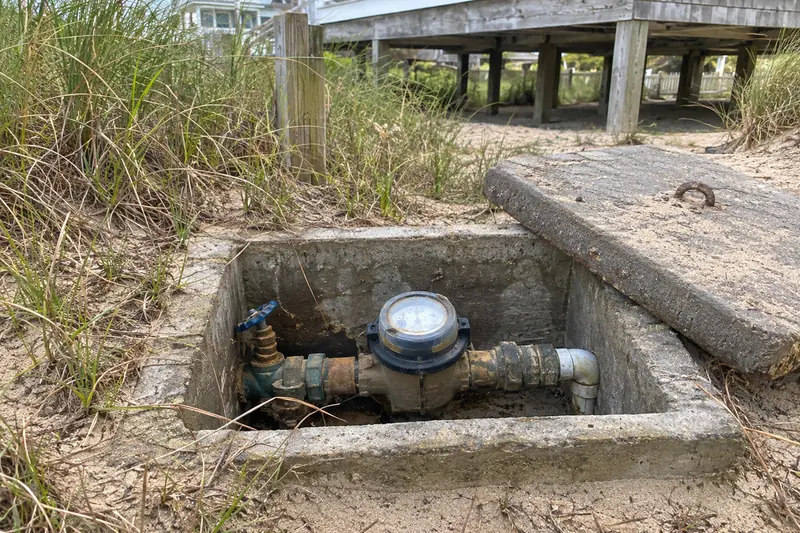
Water meter in an open concrete pit among beach grass beside a raised house
Water meter in an open concrete pit among beach grass beside a raised house. AI-generated picture.

Bring

  • The meter location and a flat screwdriver or meter key for the lid
  • Food coloring or toilet dye tablets
  • A flashlight and a notepad

The procedure

  1. Find the meter. On the islands the meter is often in a pit near the sidewalk or in a box by the house. Note the reading, including the small leak dial if it has one.
  2. Use no water for two hours. Don't run the dishwasher, washer, ice maker or irrigation. Ask anyone in the house to wait.
  3. Read the meter again. EPA WaterSense says that if the meter changes at all in that window, you probably have a leak.
  4. Test each toilet. Put a few drops of food coloring in the tank, wait 10 minutes and look in the bowl. Color in the bowl means the flapper leaks.
  5. Walk under the house. Look at the line rising from the ground, the shutoff, the water heater pan and any run along the floor framing. Wet sand or a white crust are clues.
  6. Look up, too. Check ceilings under bathrooms and the wall under the outdoor shower for stains.
  7. Plumber's step: a leak in a wall, under a slab, or on the service line between the meter and the house needs a licensed plumber.

How does the meter test find hidden leaks?

The meter counts every gallon that passes into the house. With all fixtures off, the dial should stand still. Movement means a running toilet, a dripping fixture or a pipe leak you cannot see.

Which leaks show up most after a shore-house winter?

Splits in pipes that froze, worn toilet flappers that sat dry, and outdoor shower valves that cracked when water was left in them. The outdoor shower is covered in OD-4.

The numbers behind it

FigureWhat it meansSource
More than 9,300 gallonswater an average household loses to leaks in a yearEPA WaterSense
9%share of homes with leaks wasting 50 gallons or more a dayEPA WaterSense
10 minuteswait after adding dye to a toilet tankEPA WaterSense

Watch: Finding and Fixing Home Water Leaks

From the Northshore Utility District YouTube channel. Washington State water utility; its meter box is at the street, which may differ from island houses. The still picture is stored on this site; nothing loads from YouTube until you press play. The video's advice is the channel's own; where it differs, this page's safety steps come first.

Questions owners ask

Where is the water meter on a barrier-island house?
Usually in a covered pit near the curb or in a box beside the house. Your water bill or the utility can tell you.
Can a running toilet move the meter?
Yes. A leaking flapper is one of the most common reasons the dial moves with no water in use.
Who owns the pipe from the meter to the house?
In most systems the owner is responsible for the line on the house side of the meter. Ask your water utility how it splits responsibility.
What does a white crust on a pipe mean?
Minerals left by slow drips. Treat it as a leak sign and have the joint looked at.

Sources for this procedure

Each source was opened and the cited figure or sentence checked on October 31, 2026. Steps marked PRO are described, not taught: they belong to a licensed plumber or the utility.