Skip to the page
Shore House PipesSouth Jersey shore, season by season
Procedures
WW-4Winter watch

Pipes under an elevated house

Pipes under an elevated shore house are exposed to wind and cold, so wrap them in foam pipe insulation, keep the runs short and sloped to a drain point, never block the foundation's flood openings to keep cold out, and leave heat cable to a pro using a listed product.

Time: A few hours, or a plumber's visitWho: You + a licensed plumberWhen: Late fall, before the first freeze

By the Shore House Pipes editors · sources checked October 31, 2026 · how this manual is written
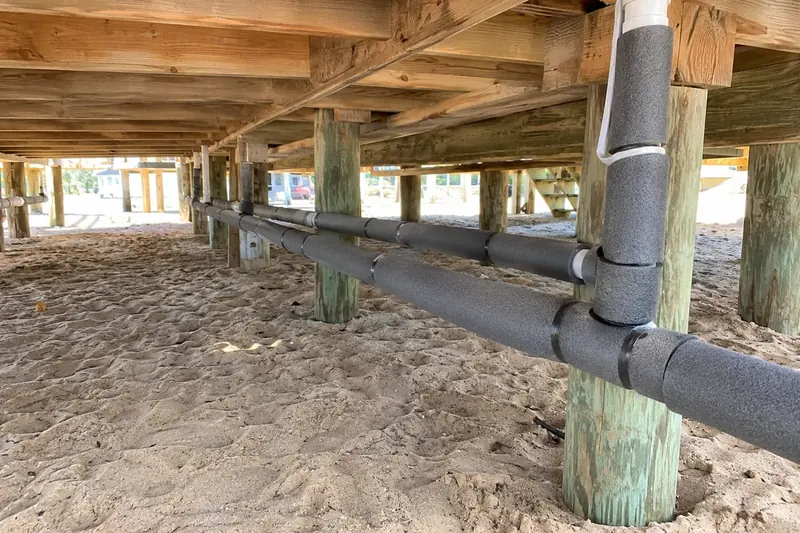
Foam-insulated pipes running along the floor framing under a house on pilings
Foam-insulated pipes running along the floor framing under a house on pilings. AI-generated picture.

Bring

  • Foam pipe insulation sized to the pipe
  • Tape rated for outdoor use
  • Gloves and a flashlight

The procedure

  1. Trace every run. Follow the main from where it rises out of the ground to where it enters the floor. Note the water heater lines, the outdoor shower and hose feeds.
  2. Insulate exposed lengths. Fit foam sleeves snugly, seams down, and tape joints. Cover elbows and valves too.
  3. Keep drains reachable. Don't cover drain caps and low-point valves; they are needed at closing.
  4. Leave flood openings open. Don't cover or block the vents in the foundation walls. FEMA requires openings that let floodwater in and out automatically.
  5. Seal around the pipe, not the vents. Fill gaps where the pipe goes through the floor with suitable sealant to cut drafts.
  6. Pro's step: heat cable (heat tape) is electrical equipment on a wet, salty site. If used, it must be a listed product, installed per its maker by a pro, on a protected circuit.
  7. Plan to re-route. If pipes keep freezing, ask a plumber about moving them inside the heated floor.

Why are elevated-house pipes so exposed?

Raising a house above the flood level puts the floor and its pipes in open air. Wind off the bay or ocean strips heat quickly, and the pipes have no warm room on the other side.

Should you close in the space under the house?

Only within the flood rules. Enclosures below elevated buildings must have flood openings: for non-engineered openings, FEMA's figure is 1 square inch of open area for every square foot of enclosed area. Talk to the town's floodplain manager before enclosing anything. See RF-1.

The numbers behind it

FigureWhat it meansSource
1 sq in per sq ftnet open area for non-engineered flood openingsFEMA Technical Bulletin 1

Questions owners ask

Does foam insulation stop pipes freezing?
It slows heat loss; it doesn't add heat. In a long cold snap an unheated pipe can still freeze.
Can I close the flood vents in winter?
No. They must stay open so floodwater can pass through.
Is heat tape a DIY job?
This manual says no: it is electrical work in a wet, salty place.

Sources for this procedure

Each source was opened and the cited figure or sentence checked on October 31, 2026. Steps marked PRO are described, not taught: they belong to a licensed plumber or the utility.